Black Openings Against 1.e4: Which Defense Should You Play?
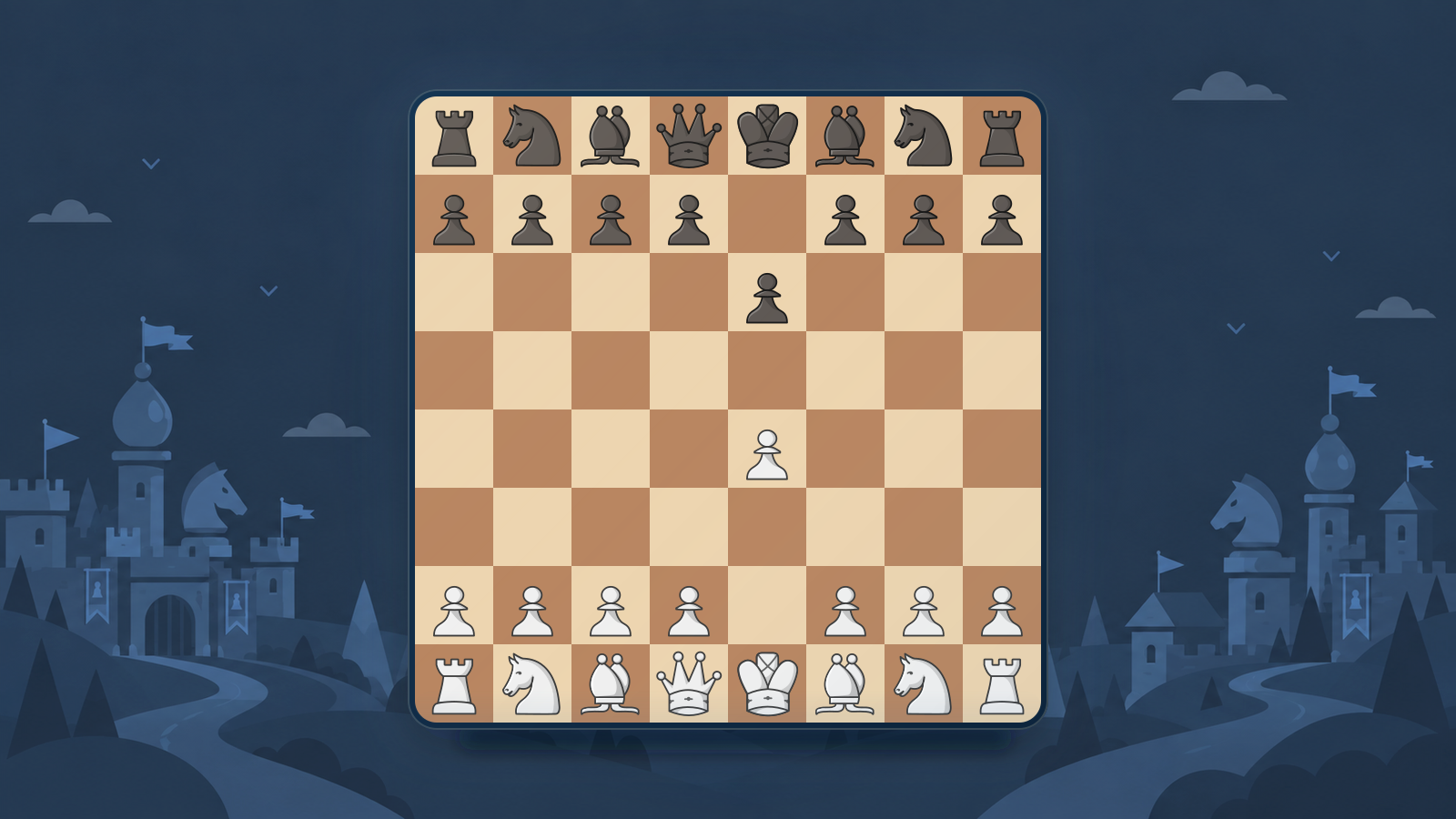
The best black defenses against 1.e4
Five defenses give Black a reliable answer to 1.e4: the Sicilian Defense, the French Defense, the Caro-Kann Defense, the Scandinavian Defense, and the Pirc Defense. Each suits a different playing style, so the best choice depends on whether you prefer sharp tactical battles or solid, positional play.
- Sicilian Defense (1...c5) — aggressive and theory-heavy; rewards tactical players
- French Defense (1...e6) — solid and strategic; suits positional thinkers
- Caro-Kann Defense (1...c6) — sturdy and practical; ideal for beginners seeking structure
- Scandinavian Defense (1...d5) — direct and easy to learn; good for club-level play
- Pirc Defense (1...d6) — flexible and hypermodern; favors patient defenders
Why 1.e4 demands a specific response
The move 1.e4 stakes a claim in the center and opens lines for White's bishop and queen, so Black usually chooses a concrete response. Compared with 1.d4, 1.e4 typically leads to an early concrete choice for Black. Each of Black's main replies — the Sicilian, French, Caro-Kann, Scandinavian, and others — produces a fundamentally different pawn structure and set of strategic priorities, so the choice shapes the entire game from the outset.
This is why players who have read general advice about black openings sometimes find that guidance doesn't translate cleanly to facing 1.e4 specifically. If your opponent regularly opens with 1.d4, that's a separate decision covered in Black Openings Against 1.d4: Which Defense Should You Play? Against 1.e4, the question is sharper: do you want to fight for the center directly, concede space and counterattack, or steer toward solid equality? Answering that question — matched to your style and the time controls you play online — is exactly what the rest of this guide addresses.
The five main defenses at a glance
Five common Black responses to 1.e4 are listed below, and each produces a distinctly different kind of game. Understanding what each one offers at a high level is the first step toward choosing the system that fits your style.
Sicilian Defense
The Sicilian Defense begins with 1...c5, and it is a popular and aggressive response to 1.e4. Rather than mirroring White's central pawn, Black fights for control of d4 from the flank, often leading to dynamic and complex positions. Players who enjoy sharp battles and are willing to invest time in theory may find the Sicilian appealing.

| 1 | e4 | c5 |
French Defense
The French Defense arises after 1...e6 and aims to challenge the center with ...d5. It produces solid, structured positions where Black accepts a slightly cramped game in exchange for a resilient pawn chain and long-term counterplay on the queenside. Players who prefer strategic maneuvering over early tactics often find the French a reliable weapon. Mikhail Botvinnik and Tigran Petrosian are among the notable players who used it as a primary defense.
Caro-Kann Defense
The Caro-Kann begins with 1...c6, again preparing ...d5 but with the c-pawn already supporting that advance. The result is a solid, slightly less cramped structure than the French, and Black typically achieves good piece activity without conceding the bishop pair. It suits players who want a sound, positional game with fewer theoretical obligations than the Sicilian.
Scandinavian Defense
The Scandinavian Defense meets 1.e4 immediately with 1...d5, challenging the center on move one. After 2.exd5, Black recaptures and develops the queen early, which can feel unorthodox but leads to clear, easy-to-understand positions. The Scandinavian is often recommended for players who want a straightforward setup that sidesteps heavy theory.
Pirc Defense
The Pirc Defense takes a hypermodern approach: Black allows White to build a broad pawn center and then works to undermine it from the flanks, typically with ...g6 and ...Bg7. It suits players comfortable with slightly passive early positions who trust their ability to generate counterplay in the middlegame.
Side-by-side comparison
Each of the five main defenses against 1.e4 has a distinct profile, and placing them side by side makes the choice considerably clearer. The table below maps each defense across four practical criteria: sharpness, theory load, beginner-friendliness, and the playing style it tends to reward.
| Defense | Style | Theory Load | Sharpness | Best For |
| Sicilian Defense | Aggressive | Heavy | Very Sharp | Tactical fighters |
| French Defense | Positional | Moderate | Moderate | Positional players |
| Caro-Kann Defense | Solid | Low–Moderate | Solid | Beginners & solid play |
| Scandinavian Defense | Direct | Low | Moderate | Club & online players |
| Pirc Defense | Hypermodern | Moderate | Dynamic | Reactive styles |
| Petrov Defense | Symmetrical | Moderate | Solid | Equality seekers |
The pattern that emerges is a rough spectrum. The Caro-Kann and French sit at the solid, positional end, asking Black to accept some early space concessions in exchange for structural clarity. The Scandinavian occupies a middle ground — easy to reach but requiring active piece play to compensate for the early queen development. The Sicilian and Pirc are associated with sharper, more dynamic positions and usually require more preparation. Familiarity with a defense matters more than memorizing every line, so the right column to weight most heavily is the one that matches how you already enjoy playing chess.
Which defense matches your playing style?
Choosing a defense against 1.e4 is ultimately a question of temperament as much as theory. The position you reach after move one sets the tone for the entire game, so picking a system that fits how you naturally think and compete makes a real difference in practice.
The Tactician — Sicilian Defense
Players who enjoy complications and are comfortable calculating sharp lines will find the Sicilian Defense a natural home. After 1.e4 c5, Black fights for control of the center without mirroring White's moves, which tends to produce dynamic and complex positions where both sides have genuine winning chances. Grandmasters including Bobby Fischer, Garry Kasparov, and Mikhail Tal all relied on the Sicilian as a primary weapon, which reflects how well it suits an aggressive, uncompromising style. The trade-off is real: the Sicilian is theory-heavy, and playing it well at higher levels demands serious preparation.
The Positional Grinder — Caro-Kann or French Defense
Players who prefer structure and long-term plans over early fireworks tend to gravitate toward the Caro-Kann or French Defense. Both defenses prioritize a solid pawn structure and clear piece development over immediate counterattack. The French in particular has a rich history at the top level — Mikhail Botvinnik and Tigran Petrosian used it as a primary weapon. The honest trade-off is that Black can end up slightly passive in the early middlegame, so patience is a genuine requirement.
The Beginner in a Hurry — Scandinavian Defense
The Scandinavian Defense (1.e4 d5) is one of the more accessible responses to 1.e4 because Black's plan is immediately clear: recapture on d5 and develop quickly. It requires less memorization than the Sicilian or French, making it a practical starting point for players who want a functional repertoire without weeks of study. The downside is that Black's queen can become a target after the early recapture, so understanding that one structural idea is essential.
The Hypermodern Experimenter — Pirc Defense
The Pirc Defense suits players who enjoy letting White build a center and then undermining it from the flanks. It is a hypermodern approach — Black deliberately delays occupying the center with pawns and instead develops pieces to pressure White's structure. This flexibility is appealing, but the defense demands a good feel for dynamic compensation, which makes it better suited to players who already have some experience reading imbalanced positions.
How to pick the right defense for you
Choosing a defense against 1.e4 comes down to four personal filters, and running through them honestly will narrow the field faster than any generic ranking.
- Theory tolerance. The Sicilian Defense demands the most memorization, with sharp lines that can diverge quickly after just a few moves. The Scandinavian and Pirc require far less book knowledge to reach a playable position.
- Time control. In blitz, simpler pawn structures pay off because you spend less time recalling theory. The Caro-Kann and French both offer clear plans that hold up under clock pressure.
- Comfort with imbalance. If you enjoy asymmetric, double-edged positions where either side can win, the Sicilian rewards that appetite. If you prefer a solid structure and a long strategic game, the French or Caro-Kann is a better fit.
- Willingness to study. Defenses with rich theory, like the Sicilian, reward dedicated preparation; defenses like the Scandinavian let you focus study time on middlegame ideas instead.
Practical note: Pick one defense and stick with it long enough to reach positions you recognize. Switching systems every few games resets your pattern library and slows improvement more than a suboptimal opening choice ever would.
Once you have a defense that fits your style against 1.e4, you may also want to settle on a parallel system against 1.d4 — that decision involves a different set of openings and is covered in Black Openings Against 1.d4: Which Defense Should You Play?
Putting your chosen defense into practice
Once you have settled on a defense against 1.e4, the goal is to build genuine familiarity rather than memorize long lines. As one widely cited principle puts it, memorizing openings is not necessary, but familiarity with the key ideas is important. The most efficient way to develop that familiarity is to play your chosen defense repeatedly in real games and review what went wrong afterward.
A few practical habits will accelerate that process:
Learn the first three to five moves and the main idea behind each one before worrying about variations.
After each game, identify the earliest move where you felt uncertain and look up that specific position rather than the whole opening.
Play the same defense consistently for several sessions before switching, so patterns start to feel automatic.
Focus on piece activity and pawn structure rather than move-order precision; most online opponents will deviate from established theory early anyway.
Use a resource such as How to beat 1.e4 as Black to check the core plans for your chosen defense without drowning in engine lines.
The repetition loop — play, review the critical moment, understand the idea, play again — builds the kind of practical recognition that serves you far better in fast online games than a memorized sequence ever could. If you later decide to add a second defense, or want to explore how the same principles apply when facing 1.d4, the article Black Openings Against 1.d4: Which Defense Should You Play? covers that parallel decision in the same practical frame.
Frequently asked questions
What is the best opening for black against e4?
There is no single best opening against 1.e4 because the right choice depends on your playing style and how much theory you want to learn. Tactical players who enjoy sharp, unbalanced positions tend to gravitate toward the Sicilian Defense, while players who prefer solid, structured play often choose the French or Caro-Kann. The defense that suits your temperament and that you understand well enough to navigate without memorizing every line will serve you better than any objectively "strongest" choice.
Is the Sicilian Defense good for beginners?
The Sicilian Defense can work for beginners, though it comes with a caveat. One source notes that the French Defense, Caro-Kann Defense, and Sicilian Defense are all recommended for beginners playing Black, so the Sicilian is not off-limits at an early stage. That said, the Sicilian leads to sharp tactical battles and carries a significant body of theory in its main lines. Beginners who choose it should start with a straightforward variation rather than diving into deeply studied lines like the Najdorf.
What is the easiest black opening to learn against 1.e4?
The Scandinavian Defense and the Caro-Kann are widely regarded as easier to pick up than the Sicilian because their structures are more predictable and Black's plans are clearer from an early stage. The Scandinavian in particular reaches a recognizable setup quickly, which reduces the amount of move-order knowledge required for online games.
Should I play the French or Caro-Kann against e4?
The French and Caro-Kann both offer solid, positional responses to 1.e4, but they suit slightly different preferences. The French accepts a somewhat cramped position in exchange for a clear pawn-break plan with ...e5 or ...c5, while the Caro-Kann gives Black a more active light-squared bishop from the outset. If you dislike having a passive bishop early on, the Caro-Kann is likely the better fit.
Our recommendation
Beginners facing 1.e4 will find the Caro-Kann Defense or the French Defense the most practical starting points. Both create solid pawn structures that are easier to navigate without deep theoretical knowledge, and sources including Kingdom of Chess note that these defenses are well-suited to players still building their fundamentals. Intermediate players who want more dynamic counterplay should consider the Sicilian Defense, which offers rich imbalances and genuine winning chances from the black side. Tactically-minded players drawn to immediate piece activity may enjoy the Scandinavian Defense. For hands-on practice after choosing a defense, use the Sicilian, French, or Caro-Kann lesson. The openings directory covers the other families.