Win Chess in 3 Moves: Is It Really Possible?
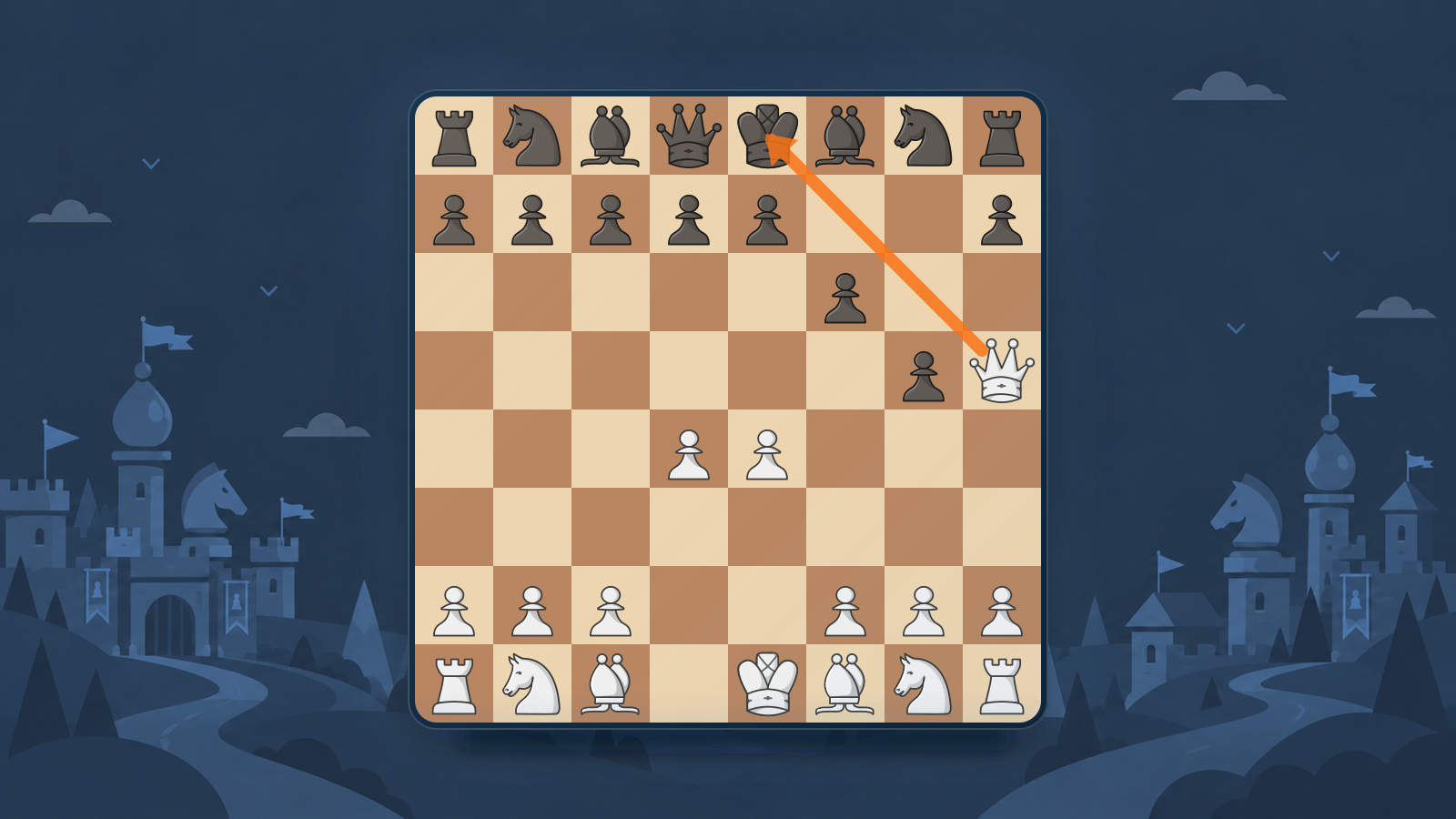
Can you checkmate in three moves?
Yes. White can deliver checkmate on White's third move if Black opens a path to the king and fails to stop the queen. Here is one legal example:
1.e4 g5 2.d4 f6 3.Qh5#

| 1 | e4 | g5 |
| 2 | d4 | f6 |
| 3 | Qh5# |
Black's g-pawn on g5 can no longer move to g6 to block the queen's line, and the f-pawn's advance leaves f7 empty. White's queen travels from d1 to h5 and checks the king on e8 along h5–g6–f7–e8. Black cannot block that check, capture the queen, or move the king to safety. The checkmate is real, but it takes two serious mistakes by Black. White cannot force it against sound defense.
Count moves carefully: 3.Qh5# is White's third move. A move by White and a reply by Black together form one full move. The final # means checkmate.
The even faster two-move Fool's Mate
The fastest possible checkmate from the starting position is delivered by Black on Black's second move:
1.f3 e5 2.g4 Qh4#
| 1 | f3 | e5 |
| 2 | g4 | Qh4# |
Here White, not Black, makes the weakening f- and g-pawn moves. Moving the f-pawn opens the e1–h4 diagonal toward White's king. The move 2.g4 does nothing to block that diagonal at g3. Black's queen reaches h4 and gives check along h4–e1. There is no legal escape, capture, or block.
These moves are an example of what can happen, not a practical opening plan. If White keeps the king safe, Black has no two-move mate.
Where Scholar's Mate fits
Scholar's Mate is often confused with a three-move mate. Its usual line ends on White's fourth move:
1.e4 e5 2.Qh5 Nc6 3.Bc4 Nf6 4.Qxf7#
The queen on h5 attacks f7 along the h5–f7 diagonal. The bishop on c4 protects f7 along the c4–f7 diagonal. Those are different diagonals. Black can stop the threat, so this line also depends on a defensive mistake. See the step-by-step Scholar's Mate guide for the board and a sound response.
What to learn from quick mates
- Before moving a pawn near your king, check whether it opens a line for the opponent's queen or bishop.
- When an enemy queen comes out early, identify its target before making a routine developing move.
- Checkmate means the king is in check and has no legal escape, capture, or block. A quick threat is not a forced win if the opponent can defend it.
To practice these patterns, play a game. For the rules and piece movements, start with ChessHotel Learn.