How to Win Chess in 4 Moves: Scholar's Mate Steps and Defense
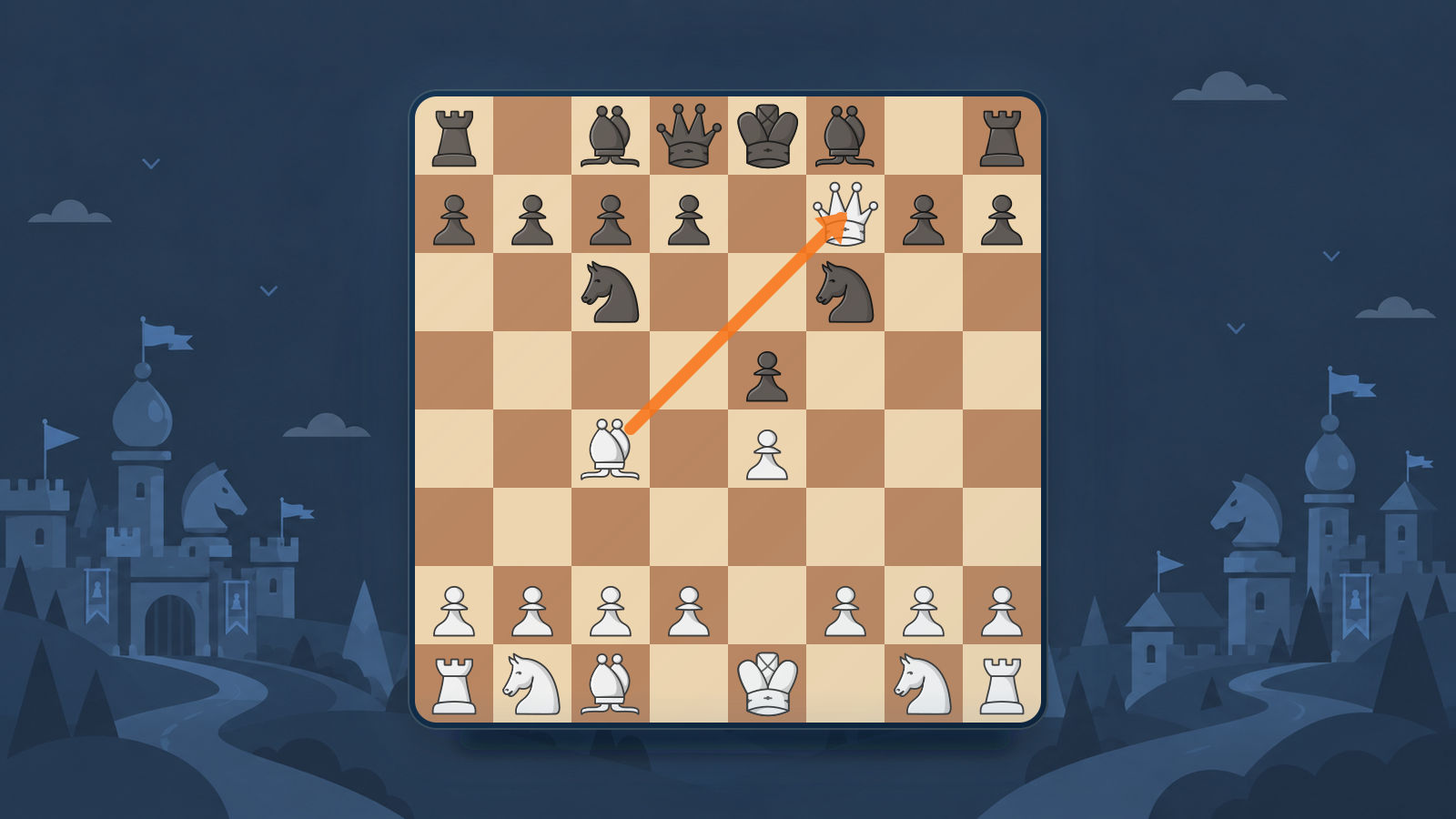
The exact 4-move checkmate (Scholar's Mate)
If you want to checkmate your opponent in four moves, here is the sequence, playing White, known as Scholar's Mate:
- e4 — White opens with the king's pawn, claiming central space and opening a diagonal for the bishop.
- e5 — Black mirrors the move (this is the response the trick depends on).
- Qh5 — The queen steps out early, eyeing two things at once: the pawn on e5 and, more importantly, a future landing square that lines up with f7.
- Nc6 (or another developing move) — Black develops a knight, not yet aware of the threat building on the kingside.
- Bc4 — The bishop aims at f7 from c4. It protects the queen if she captures on f7; the two pieces approach that square from different diagonals.
- Nf6 (or another non-defensive move) — Black continues developing, still not addressing f7.
- Qxf7# — The queen captures the f7 pawn, delivering checkmate. The bishop on c4 supports the queen, so it cannot be captured by the king, and no Black piece can block or capture it.

| 1 | e4 | e5 |
| 2 | Qh5 | Nc6 |
| 3 | Bc4 | Nf6 |
| 4 | Qxf7# |
Written out as a single line, the winning sequence is: 1.e4 e5 2.Qh5 Nc6 3.Bc4 Nf6 4.Qxf7#. Every beginner should be able to reproduce this from memory after a few tries on a real board.
The reason this sequence checkmates rather than merely checks is worth pausing on. When the queen lands on f7, she checks the king on e8. Black's own pieces occupy its available escape squares, and the bishop on c4 protects the queen from the king. There is no legal escape, capture, or block.
Why f7 is the target
Scholar's Mate is not a random sequence of moves; it exploits a specific structural weakness that exists in the starting position of every chess game.
At the start, the f7 pawn (f2 for White) is defended only by its king. An attack by a bishop and queen can therefore create a quick threat if Black overlooks it.
Scholar's Mate attacks that soft point with two pieces from different diagonals. The bishop on c4 attacks f7 along c4–d5–e6–f7. The queen on h5 attacks it along h5–g6–f7. After Qxf7#, the bishop protects the queen, so the Black king cannot capture her.
This is also why move order matters: the queen goes to h5 before the bishop goes to c4 in the standard sequence, but the mating idea only works once both pieces are aimed at f7 and Black has failed to defend the square or block the diagonal. If Black interferes at any point — by developing a piece that covers f7, blocking the diagonal, or attacking the queen — the whole plan collapses, which is exactly why this pattern is a trap that depends on a specific mistake, not a guaranteed win.
How to defend against Scholar's Mate as Black
If you are on the receiving end of 1.e4 e5 2.Qh5, you do not need to panic or memorize a long defense. One idea solves the problem: get a piece to guard f7, or block the diagonal, before the bishop and queen both arrive.
First protect the e5 pawn with 2...Nc6. If White then plays 3.Bc4, 3...g6 attacks the queen and stops Qxf7#. For example, 1.e4 e5 2.Qh5 Nc6 3.Bc4 g6 4.Qf3 Nf6 is a legal defensive line. The move 2...Nc6 alone does not stop the mate threat; Black must answer it on the next move.
The tempting 2...Nf6 attacks the queen but leaves the e5 pawn unprotected: White can play 3.Qxe5+. It prevents the immediate Scholar's Mate pattern, but it is a poor example of a clean defense.
What you should avoid is playing purely natural-looking developing moves without checking what they defend. The trap catches players precisely because 2...Nc6 and 3...Nf6 look like ordinary development — and they are, in general — but they do nothing to stop the queen and bishop from reaching f7. The single habit that defeats Scholar's Mate every time is this: whenever your opponent's queen comes out early, ask what it is attacking before making your own natural-looking move.
What the final position looks like and why the king can't move
A check simply means the king is under attack and must respond — by moving, blocking, or capturing the attacker. Checkmate means none of those options exist.
At the end of the Scholar's Mate sequence, after 4.Qxf7#, the Black king sits on e8 with the queen delivering check from f7. Look at what happens if the king tries each option:
- Capture the queen: illegal, because the bishop on c4 is aiming straight down the a2-g8 diagonal through f7, so capturing would leave the king in check from the bishop instead.
- Move the king: every adjacent square — d7, e7, d8, f8 — is either occupied by a Black piece, attacked by the queen, or attacked by the bishop. There is nowhere safe to go.
- Block the check: no Black piece can be inserted between the queen and the king in a single move, because the queen is delivering the check from directly adjacent to the king (on f7 next to e8), leaving no space to interpose.
- Capture with another piece: no other Black piece can reach f7 in time.
With every option eliminated, the position is checkmate and the game ends immediately. This is the pattern worth internalizing: checkmate always comes down to the same three questions — can the king move, can the attacker be captured, can the check be blocked — and Scholar's Mate is a clean example of all three answers being no at once.
Common mistakes that break the 4-move win
Even when a reader knows the moves, a few common slip-ups prevent the mate from landing:
- Assuming move order guarantees mate. White can develop the bishop before the queen, but either order gives Black chances to notice and defend f7.
- Ignoring an attack on the queen. If Black plays 2...Nf6 and White ignores the knight attack with 3.Bc4, Black can capture the queen with 3...Nxh5.
- Assuming the opponent will develop passively. The entire plan depends on Black making natural-looking but non-defensive moves. Against any player who has seen this pattern before, White's queen sortie to h5 is more often a liability than a threat, because it wastes time and can be attacked.
- Confusing check with checkmate mid-sequence. Some beginners think 4.Qxf7 is automatically game-over and miss that if Black's king or another piece can legally respond, the game continues and White's queen is now exposed deep in enemy territory with no support.
- Trying to force the pattern when the position doesn't allow it. If Black has already played a move that defends f7 or blocks the diagonal, continuing to chase the same four moves usually just loses material or time. The trick only works when the specific setup is present — it is not a mechanical four-move formula that overrides whatever the opponent actually plays.
When Scholar's Mate actually works — and when it won't
Scholar's Mate is a real checkmate in the illustrated line, but White cannot force it from the starting position. It succeeds only if Black fails to meet the threat to f7.
Here's a practical way to think about who this works against:
| Opponent experience | Likely outcome |
| First-time player, no opening knowledge | Mate often succeeds if they develop naturally without checking threats |
| Beginner who has played a few dozen games | May spot the threat and answer with ...g6 after developing the b8-knight |
| Anyone who has faced this trick before | Usually defends automatically, and White's early queen move becomes a wasted tempo |
| Club player or above | Treats 2.Qh5 as a minor inaccuracy to exploit, not a threat to fear |
This lines up with a common piece of advice worth taking seriously: relying on Scholar's Mate as a repeated strategy is not a good habit to build, because it teaches a pattern that stops working the moment an opponent knows the single defensive idea. Practicing it once or twice is a useful way to learn about weak squares, batteries, and the mechanics of checkmate — but it should not become a crutch.
If your opponent defends f7 or attacks the queen, the four-move win is off the table. Respond to the actual threat, develop your pieces, and contest the center. Trying to force the same sequence against a defended position can cost time or material.
Try the pattern in a game on ChessHotel, or review checks and piece movement in ChessHotel Learn.