Sicilian Defense Explained: Core Ideas and Main Variations
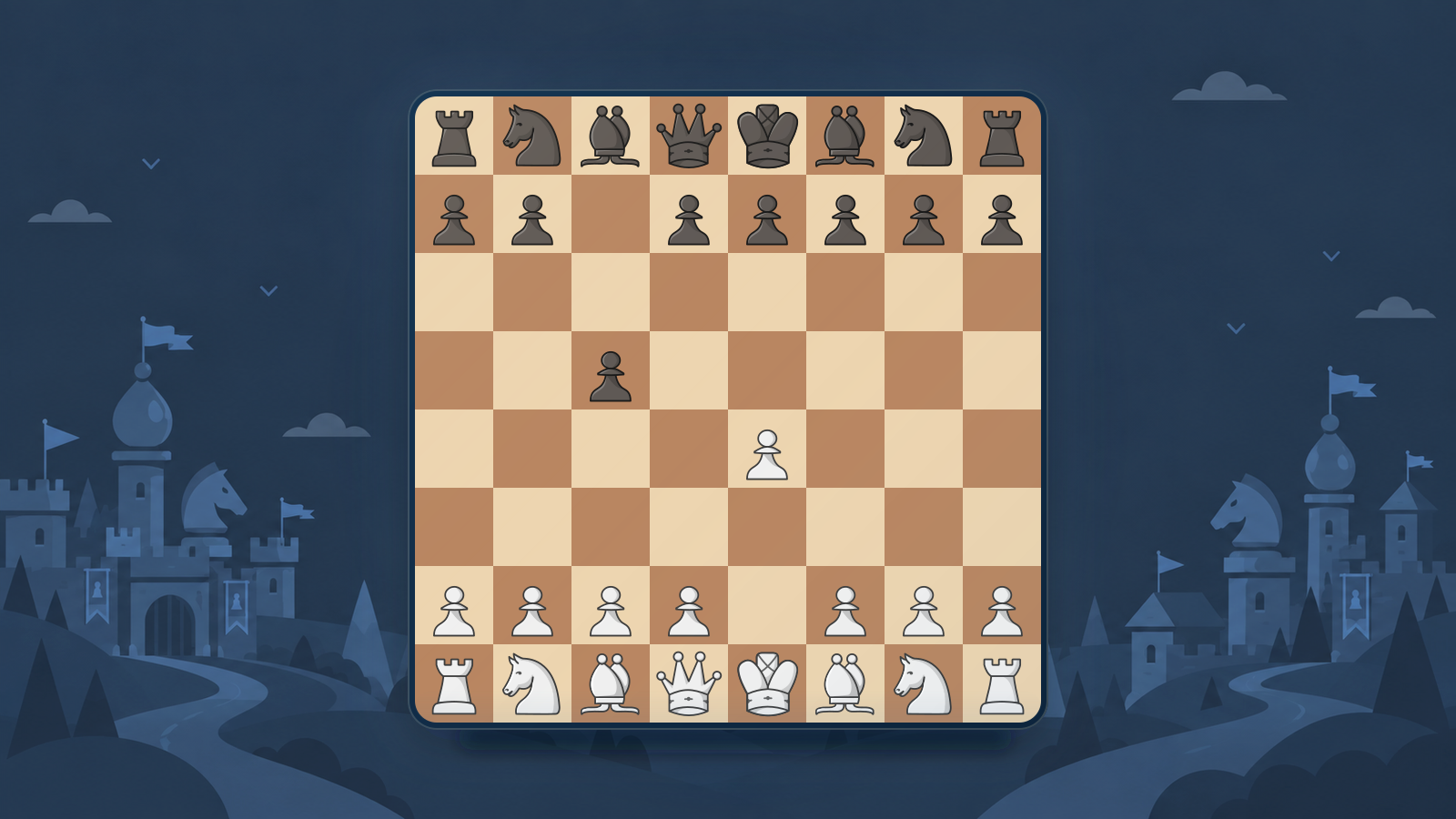
The Sicilian Defense at a glance
The Sicilian Defense begins with 1.e4 c5 — White advances the king's pawn, and Black answers not by mirroring that move but by pushing the c-pawn instead. That single decision sets the tone for everything that follows: rather than a symmetrical struggle, Black creates an imbalanced position from the very first move, aiming for counterplay on the c-file and queenside while White typically pursues kingside activity.

| 1 | e4 | c5 |
The result is a dynamic, complex game where both sides have genuine winning chances, which is a large part of why the Sicilian Defense has remained one of the most played responses to 1.e4 at every level of chess.
Core ideas behind 1...c5
This single decision sets the tone for everything that follows. Rather than establishing immediate symmetry, Black stakes a claim in the center from an angle, creating the kind of imbalanced pawn structure that gives both sides genuinely different plans to pursue.
Why Black avoids mirroring with 1...e5
Responding to 1.e4 with 1...e5 produces a symmetrical pawn center and leads to open games where White, moving first, often dictates the pace. Black can defend adequately, but the positions tend to revolve around White's initiative. By playing 1...c5 instead, Black fights for control of the center without copying White's structure. The c5-pawn exerts pressure on the d4-square, making it harder for White to establish a dominant pawn on d4 without conceding something in return. Crucially, if White later plays d4 and Black captures with cxd4, Black ends up with a d-pawn against White's e-pawn — an asymmetry that gives each side a different set of strengths and weaknesses to exploit.
Strategic goals for both sides
For Black, the Sicilian Defense is fundamentally about counterplay. The open or half-open c-file that typically results from an early pawn exchange becomes a highway for Black's rooks and a platform for queenside pressure. Black accepts that White will often have more central space and kingside activity in the short term, but bets on generating enough counterplay — especially on the queenside — to more than compensate. This deliberate imbalance is the engine of the Sicilian's appeal: Black is not trying to equalize quietly but to create a fight on favorable terms.
White's goals run in the opposite direction. With the extra central space that 1.e4 provides, White typically aims to build a kingside attack, often launching pawns or pieces toward Black's king after castling. The tension between White's kingside ambitions and Black's queenside counterplay is what makes Sicilian positions so dynamic and strategically rich.
The Sicilian's imbalance is intentional, not a concession. Black is trading short-term central space for long-term counterplay — understanding that exchange is the foundation of every Sicilian branch.
How the Sicilian plays out in practice
A Sicilian game takes its most characteristic shape when White responds to 1...c5 with 2.Nf3 followed by 3.d4. This sequence — known as the Open Sicilian — often produces double-edged positions. After Black captures on d4 with 3...cxd4 and White recaptures with the knight (4.Nxd4), both sides have staked out their territory and the real strategic contest begins.
The Open Sicilian pawn structure
The position after the early exchanges leaves a distinctive pawn structure that shapes everything that follows. White keeps central space with the e4 pawn, while Black seeks counterplay against it. Black, meanwhile, has no pawn on d5 or e5 to contest that space immediately, but has already traded the c-pawn for White's d-pawn — an asymmetrical exchange that carries long-term consequences.
| 1 | e4 | c5 |
| 2 | Nf3 | Nc6 |
| 3 | d4 | cxd4 |
| 4 | Nxd4 |
The key structural feature is the half-open c-file that Black now controls. After early exchanges, Black often has a half-open c-file that can support rook activity and queenside pressure. White, by contrast, retains the e4 pawn as a central anchor and often looks to use the d5 square — which Black's missing c-pawn can no longer guard — as an outpost for pieces. This imbalance is a key part of the Sicilian's counterplay-oriented character.
Typical plans for White and Black
The asymmetry in the pawn structure translates directly into each side's plans. Rather than fighting over the same territory, White and Black tend to pursue counterplay on opposite wings, which is what gives Sicilian games their characteristic tension.
White's typical plans include:
- Launching a kingside attack, often involving f4–f5 or a piece sacrifice to crack open lines toward Black's king
- Using the d5 outpost to plant a knight or bishop that Black struggles to dislodge
- Controlling the center with the e4 pawn and restricting Black's piece activity
Black's typical plans include:
- Pressing on the queenside along the c-file and the b-file, often doubling rooks or advancing the b-pawn
- Preparing a central break with ...d5 when the timing is right, challenging White's spatial advantage directly
- Keeping the position complex enough that White's kingside ambitions can be met with active counterplay rather than passive defense
This mutual aggression on opposite flanks is what makes the Sicilian feel different from quieter 1.e4 defenses. Neither side is simply reacting; both are building toward their own goals simultaneously. For a player new to the opening, recognizing these directional plans — White pressing toward the kingside, Black generating queenside and central counterplay — is more valuable than memorizing specific move sequences. The Sicilian Defence on Wikipedia offers a useful reference for how these structural ideas have evolved across decades of high-level play.
A map of the main Sicilian families
The Sicilian Defense is a family of systems reached through different move orders. The board below shows a common Open Sicilian position after 2...d6. From here, Black can play 5...a6 for the Najdorf, 5...g6 for the Dragon, or 5...e6 for a Scheveningen setup. Other families branch earlier, so recognizing Black's second move matters as much as memorizing a variation name.
| 1 | e4 | c5 |
| 2 | Nf3 | d6 |
| 3 | d4 | cxd4 |
| 4 | Nxd4 | Nf6 |
| 5 | Nc3 |
In the position shown, the Najdorf starts with 5...a6, the Dragon with 5...g6, and the Scheveningen with 5...e6. The Taimanov and Kan commonly start with 2...e6: after 3.d4 cxd4 4.Nxd4, Black can choose 4...Nc6 or 4...a6. The Sveshnikov uses an earlier 2...Nc6 and often reaches 3.d4 cxd4 4.Nxd4 Nf6 5.Nc3 e5. These move orders create different pawn structures and plans; they are not six choices from the same board position.
Each branch shares the same foundational Sicilian logic — asymmetry, queenside counterplay, and central tension — but expresses it through a different pawn structure and piece arrangement. Recognizing which family you have entered is the first practical skill the opening demands.
Recognizing the Sicilian in your own games
The Sicilian Defense announces itself immediately: after you play 1.e4 as White, your opponent responds with 1...c5, pushing the c-pawn two squares forward rather than mirroring your move with 1...e5. That single move is the signal. The board has not yet developed into anything complex, but the strategic direction is already set — Black is staking a claim on the d4 square and preparing queenside counterplay rather than fighting for the center symmetrically.
As the game continues into the Open Sicilian after 2.Nf3 and 3.d4, you will notice a distinctive pawn structure taking shape. White typically holds a pawn on e4 after Black's c-pawn captures on d4 and White recaptures with the knight. This leaves a half-open c-file for Black and a half-open d-file for White. That c-file becomes one of the most important features of the position — Black's rooks and queen will often aim to use it for queenside pressure, which is the imbalanced counterplay the Sicilian is built around.
Recognizing this structure in your own games means paying attention to two things: where the tension lies and which side of the board each player is targeting. White tends to build kingside attacking chances, while Black works on the queenside. Once you see that dynamic on the board, you know the Sicilian's core logic is in motion.
Simple tips for blitz and rapid games
Blitz and rapid formats reward pattern recognition over calculation, so a few grounding principles help when the Sicilian appears on your board.
Develop your pieces toward the center before committing to a specific plan — the Sicilian's complexity punishes early aimless moves.
Avoid early queen moves unless you have a concrete reason, since the queen can become a target in the open lines the Sicilian creates.
As Black, keep the c-file in mind as a long-term asset; placing a rook there early is rarely wrong.
As White, resist the urge to trade away your e4 pawn without gaining something concrete — it anchors your central space.
If you are unsure which branch you have entered, focus on piece activity and king safety rather than trying to recall specific move orders.
The Sicilian Defence overview on Wikipedia offers a useful reference if you want to cross-check a position you encountered after a game.
Common questions about the Sicilian Defense
Is the Sicilian Defense good for beginners?
The Sicilian Defense is playable for beginners, though it rewards players who are comfortable with imbalanced positions and counterattacking chess. Because Black deliberately avoids mirroring White's pawn structure, the resulting positions often require a feel for long-term plans rather than simple piece development. One source notes that the Sicilian is favored by aggressive players but can be challenging for those who prefer clear, straightforward plans. That said, learning its core ideas early — queenside counterplay, central tension, and the importance of the c-file — builds strategic habits that pay off at every level.
What is White's most common response?
After 1.e4 c5, White's sharpest and most theoretically rich reply is 2.Nf3 followed by 3.d4, opening the center and entering the Open Sicilian. This exchange gives White a central pawn majority while Black gains the half-open c-file for counterplay. White can also choose quieter Anti-Sicilian systems that sidestep the main theory, but the Open Sicilian remains the critical test of Black's setup.
Which variation should I try first?
This article maps the main Sicilian families — Najdorf, Dragon, Scheveningen, Taimanov, Kan, and Sveshnikov — to help you recognize what each one looks like. Choosing among them depends on your style and goals, which goes beyond the scope of this explainer. For guidance on building a full opening repertoire, the broader chess openings section is the right place to continue.
How does the Sicilian compare to other 1.e4 defenses?
The Sicilian's defining feature is the asymmetry it creates from move one. Rather than contesting the center directly with 1...e5, Black stakes out queenside space and plans to fight back dynamically. This makes the Sicilian structurally distinct from other 1.e4 responses, though a full comparison belongs in a dedicated openings guide rather than here.
The Sicilian's imbalanced pawn structure means both sides are playing for a win — draws are less common than in symmetrical openings, which suits players who want decisive results.
Key takeaways
The points below capture the essential ideas from this guide — a quick reference before you sit down for your next online game.
The Sicilian Defense begins with 1.e4 c5 — Black's c-pawn challenges White's center without mirroring it.
Playing 1...c5 instead of 1...e5 creates an asymmetrical position from move one, giving Black independent counterplay rather than a symmetrical fight.
Black's main strategic goal is queenside pressure and counterattacking chances; White typically aims for a kingside attack and central space.
The Open Sicilian arises after White plays 2.Nf3 and 3.d4, opening the center and sharpening the game considerably.
The major branch families — Najdorf, Dragon, Scheveningen, Taimanov, Kan, and Sveshnikov — share the same first move but lead to very different pawn structures and plans.
In blitz and rapid games, focus on piece development and recognizing your pawn structure rather than recalling specific move sequences.
The Sicilian is considered playable for beginners, though it rewards comfort with imbalanced positions.
Next, practise Black's moves in the interactive Sicilian Defense lesson. You can compare it with other systems in the openings directory or the famous openings guide.