Chess Opening Principles Every Beginner Should Know
Four questions to ask in every opening
You do not need a long sequence of memorized moves to play a sensible opening. Ask four questions instead: Am I developing my pieces? Am I contesting the center? Is my king safe? Are my pieces working together? These are guides for choosing moves, not rules that override a direct threat.
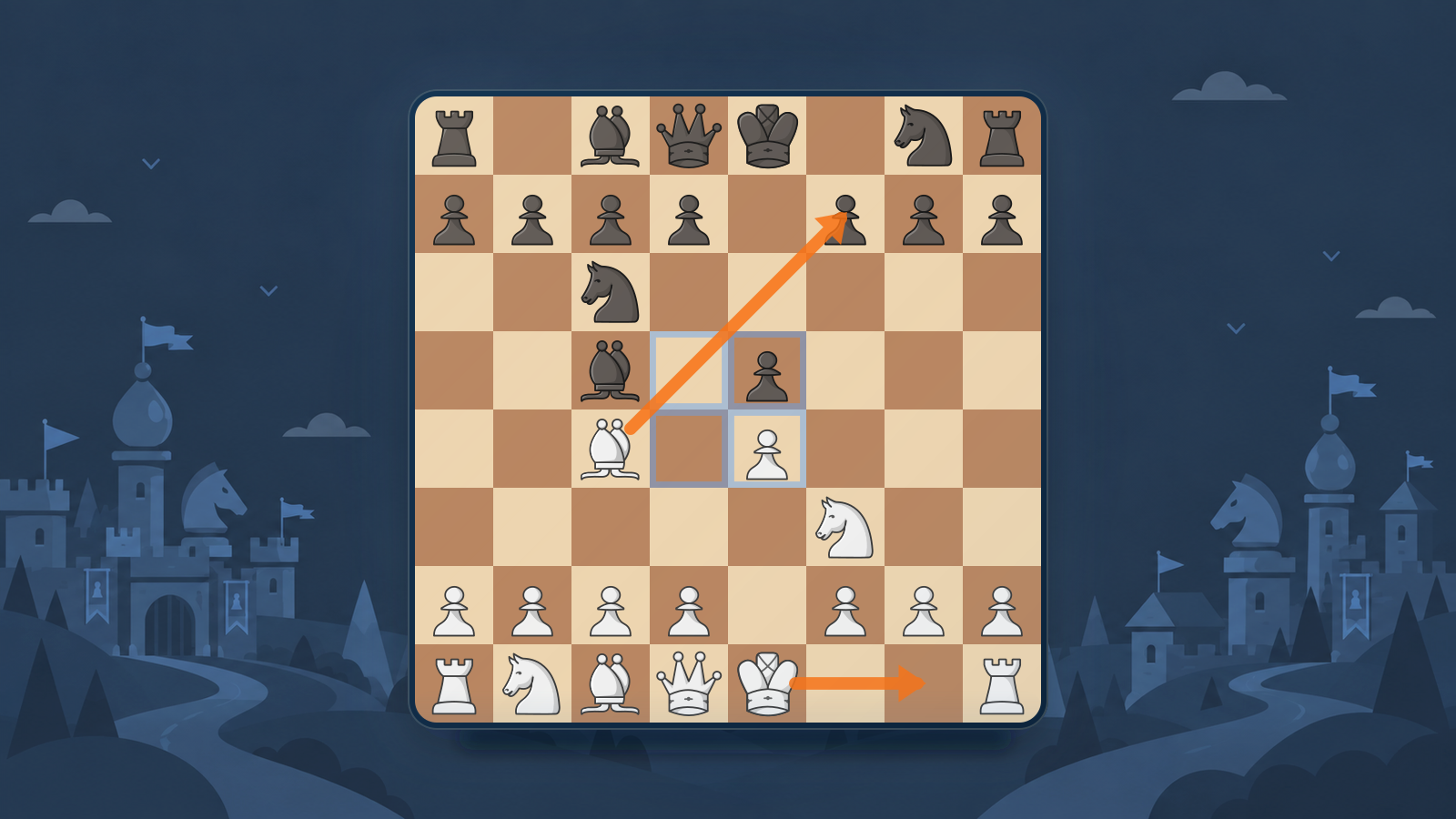
The board above shows the position after 1.e4 e5 2.Nf3 Nc6 3.Bc4 Bc5. Look at it as one position, rather than a line to memorize. The blue rings mark the four central squares: d4, e4, d5, and e5. One arrow shows White's bishop on c4 aiming at f7. The other shows that White can castle kingside. White's knight on f3 also influences the center, while the knight on b1 and bishop on c1 still need useful squares. Each of the four principles points to something you can actually see.
1. Develop your pieces
Development means bringing a piece from its starting square to a place where it has a job. In the board above, White's knight on f3 helps fight for e5 and d4. The bishop on c4 looks toward Black's kingside. Those moves also clear the path to castling.
As a beginner, look for useful squares for your knights and bishops early. Avoid moving the same piece repeatedly when another piece could join the game. An early queen move can be fine for a concrete reason, but if your opponent can chase the queen while developing, you have given them useful moves for free.
Ask: Which of my pieces is still on its starting square, and where could it help?
2. Contest the center
The center is the group of squares d4, e4, d5, and e5. A piece in or near the center can often reach more of the board than one stuck on the edge. In the example, White's e4-pawn and Black's e5-pawn occupy central squares, while the knights put pressure on nearby ones.
You do not need to push every center pawn immediately. A knight can attack a central square, and a pawn can support one from beside it. Before making a flank move, check whether your opponent could take over the center while your pieces are still at home.
Ask: Which central squares do my pawns and pieces occupy, attack, or support?
3. Keep your king safe
The king starts in the middle of the board, where open files and diagonals can become dangerous. Castling often moves it away from that traffic and brings a rook closer to play. In our example, White has moved the f1-bishop and g1-knight, so kingside castling is available. 4.O-O is one sensible continuation; White could also make another useful developing move first.
Castling is a plan, not a deadline. Check for immediate threats and make sure the destination is safe. You cannot castle while in check, through a square your king would cross under attack, or into check.
Ask: Is my king exposed, and can I castle safely soon?
4. Give your pieces useful jobs together
A developed piece can still be ineffective. A bishop blocked by its own pawns or a knight with no good square may have moved but achieved little. Piece activity means having useful targets and mobility; coordination means your pieces support a plan rather than pulling in unrelated directions.
On the board, White's bishop bears down on f7, the knight helps control central squares, and the e4-pawn gives both pieces room. White does not yet have an attack that wins by force. The pieces simply make it easier to choose a sound next move. After castling, White can consider d3 to support e4 and open the c1-bishop, or c3 to prepare d4. Black's reply determines which plan makes sense.
Ask: What is each piece doing, and does my next move help the others?
Use the principles without playing on autopilot
A useful opening move often serves more than one goal. 2.Nf3 develops a knight, attacks e5, and clears g1 for castling. 3.Bc4 develops a bishop, points toward f7, and clears f1. That is why this position makes a good teaching example: the moves have visible purposes.
Still, check your opponent's last move before applying a principle. If a pawn is hanging or a piece is threatened, deal with the concrete position first. There is no rule that says you must castle immediately or never move a piece twice. The four questions help you find candidate moves; they do not replace looking for tactics.
Try them in your next game on ChessHotel Play. When you finish, revisit one early decision: which of the four questions helped, and which did you overlook? For guided practice, try an interactive opening lesson. Once these ideas are familiar, chess book moves will make more sense because you can see why a standard move belongs in an opening.